
Environmental values play an important role in Teosto’s operations, and our goal is to become a carbon-neutral organisation. We track the carbon footprint of our operations and offset the annual carbon dioxide emissions they cause.
We strive to prevent and reduce the harmful impact of our operations on the environment and promote the sustainable use of natural resources.
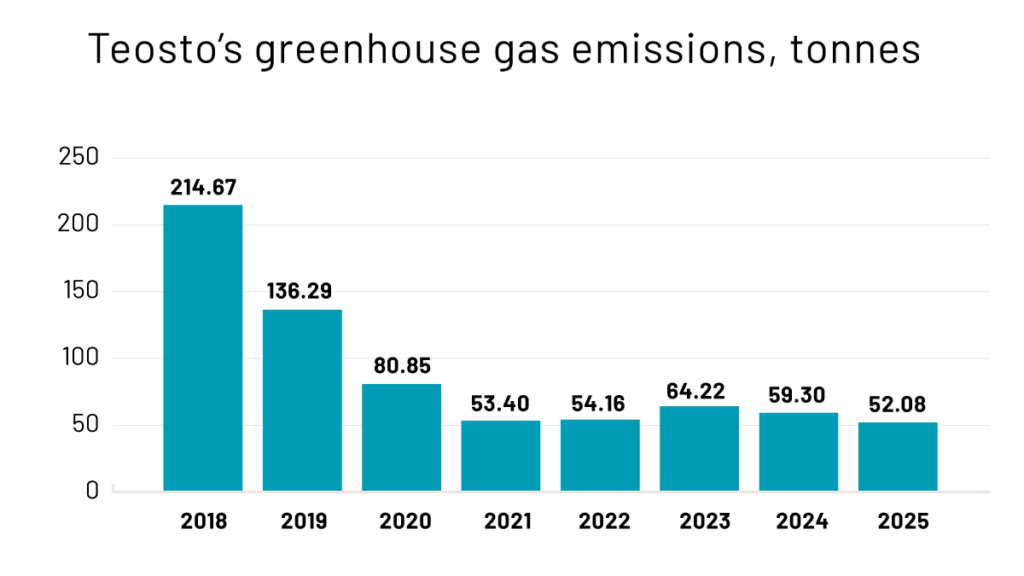
We cooperate broadly with the entire industry to promote the adoption of environmentally friendly ways of working in the music industry. We are part of the Finnish KEMUT network, the goal of which is to foster sustainable development in the music industry. We are committed to the live music climate roadmap, compiled by the network. Our carbon dioxide emissions have fallen to less than a quarter of the amount in 2018, which is when we started measuring our emissions.
Use and recycling of materials
We have held a WWF Green Office certificate for more than 10 years. The goal-oriented and measurable Green Office activities reduce the environmental impacts caused by the workplace. We take the recommendations of the Green Office system into account in all of our purchases as well as our fixtures and fittings. We take care of recycling all the waste types generated by our operations at our premises (plastic, cardboard, paper, biowaste, glass, metal, hazardous waste).
Our premises in Keilaniemi, Espoo, have been awarded BREEAM In-Use certificates. BREEAM In-Use is an international environmental certification system that includes categories related to health and well-being, energy, water, mobility, resources and waste management, land use and preparing for climate change. Our premises were rated Excellent, which is the second-highest rating.
Energy efficiency
Improving energy efficiency reduces energy consumption, which directly leads to lower emissions if the energy is produced from fossil fuels. We strive to improve our energy efficiency in everything we do, i.e. to take our carbon footprint into account and generate as little emissions as possible.
This means that we only travel when it is absolutely necessary, use green electricity in our property, and primarily only serve vegetarian food at our events.
A significant proportion of Teosto’s carbon dioxide emissions have previously been generated by the energy consumption of properties. Over the years, the amount of space we use has decreased significantly, which has also helped to reduce emissions. Our property has excellent transport links (metro, tram) and its parking facilities have charging points for electric cars. This promotes environmentally friendly mobility.
In connection with the BREEAM In-Use certification, our Port of Music property was praised for its energy-saving lighting solutions and its energy-efficient lifts, among other things. Users also have the opportunity to adjust the lighting and the temperature. In addition, all the plumbing fixtures use very little water. As a result of all this, our energy consumption decreased by a further 11% year-on-year.
Emissions and their reduction
Our goal is to become a carbon-neutral organisation. We have tracked our carbon footprint and offset our emissions since 2018. Our tracking covers the carbon footprint of things like business travel, the energy we consume, waste, company cars and commuting as well as the food served at our events.
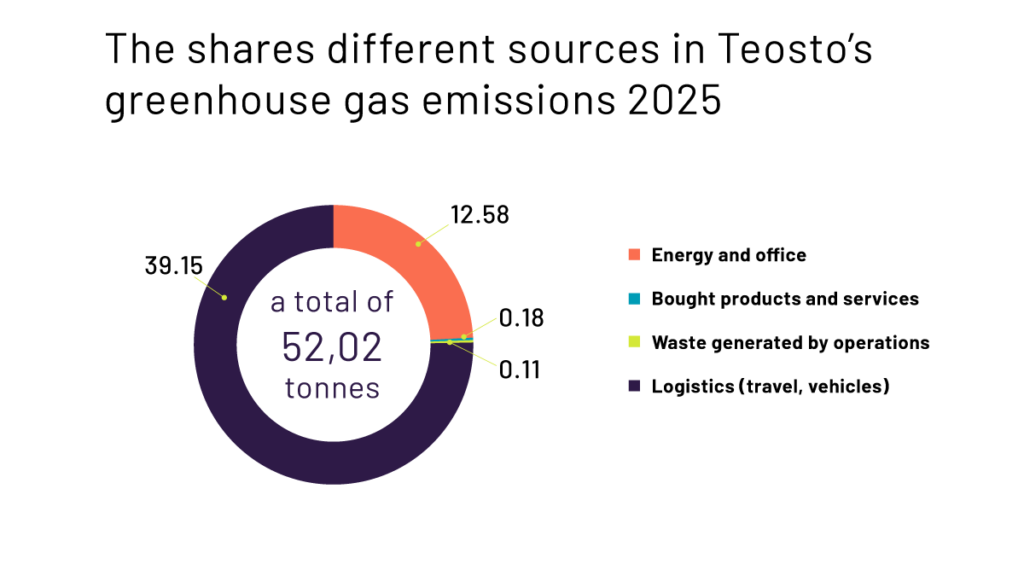
In 2025, our total carbon footprint was 52.02 tonnes (2024: 59.34 tonnes). According to Teosto’s company car policy, all leased vehicles must be fully electric, and negotiations with foreign partners are conducted remotely as much as possible.
In 2025, our largest source of emissions was mobility, which includes business travel: 39.15 tonnes (2024: 42.2 tonnes). Our focus on international activities, lobbying and advocacy efforts at the EU level, and large-scale international system overhaul projects have required international air travel. At the same time, however, the switch to electric vehicles has reduced emissions caused by leased vehicles to a minimal level, and we also use rail transport for domestic travel to a large extent.
In addition to travel, our largest amount of emissions was from energy, comprising electricity consumption and heating, which totalled about 12.58 tonnes (2024: 14.2 tonnes).
Although the goal is to reduce our carbon footprint every year, not all emissions can be completely prevented. For this reason, we offset our carbon footprint by taking part in a WWF Gold Standard-certified project every year. Emission offsetting refers to cancelling out the negative climate impact of the emissions by reducing or sequestering an equal amount of emissions elsewhere. The Gold Standard certification ensures that the climate impact and sustainability benefits are verified according to an internationally recognised standard.
In 2025, we offset our carbon footprint by supporting the Indonesia Biogas Programme. It supports local small-scale farmers by providing clean energy for cooking, reducing emissions and improving living conditions through sustainable agricultural practices. Read more about the project on the Gold Standard website.